
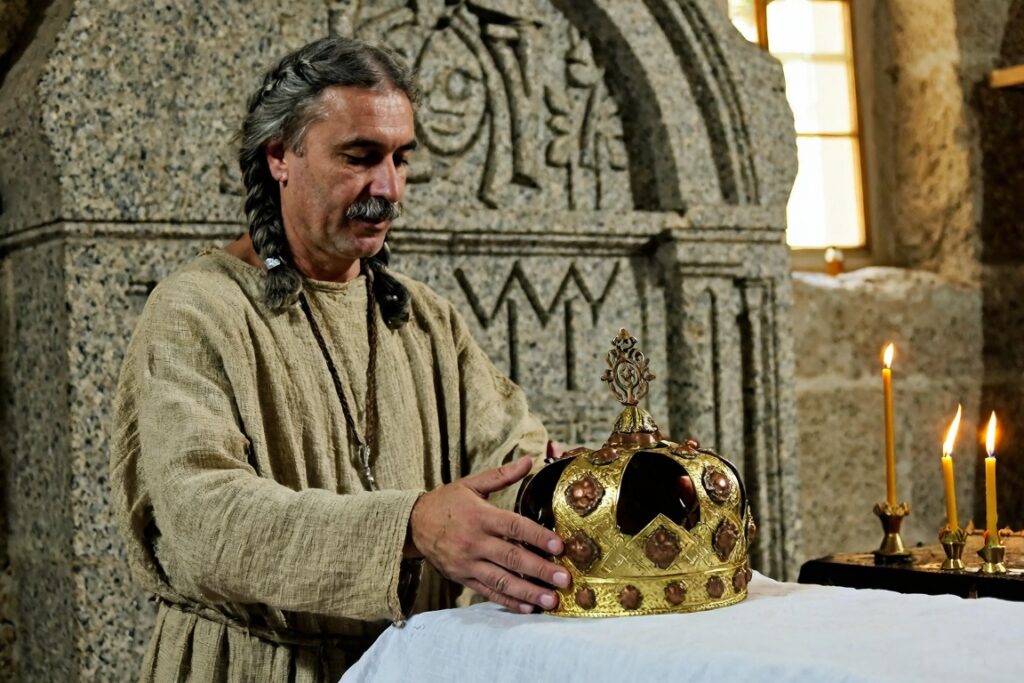
Sacred context of the ZaVED.
Essence of the revelation (6454 from S. M./946 CE). Vyshen (the Heavenly Father) gives Princess Olga (Tsaritsa of Artaria) a ZaVED on three silver tablets as a divine covenant for preserving the Lineage.
Decisive requirement: the lineage must voluntarily renounce power (“dissolve among the people”) in order to free itself from the curse. The tsars become “guardians” among the people without losing their dignity. Transgressors are punished not physically but through spiritual degradation: “they shall perish in spirit and in their souls”; their descendants shall become “useless refuse”.
Prophecy of the future “Daughter”
Olga is called the forerunner of the Messiah: through her shall be born She who “shall be a Mother to the peoPLE”, who shall manifest the Power of AiRa, the mother of Vyshen himself. Her appearance shall mark the end of the age (“the end of days”) and shall give the people “Power”. The silver Wreath of Primogeniture upon her head shall become a symbol of the union of the LINEAGES and of that which shall be decreed for the peoples (“as She decides — I shall fulfil”).
Historical Events through the Prism of the ZaVED
1. Princess Olga (X century) and the “purging of Rus’”
Revenge against the Drevlians (946): Traditionally interpreted as a brutal reprisal. According to the ZaVED, this was ritual atonement for the murder of Igor, a murder that violated the RULEs.

Olga’s conversion (955) never occurred. Olga arrives at her home, which is in the territory of the Greeks: She does not renounce the faith of her ancestors, but meets her daughter Zlatoslava, who lives in this palace with her spiritual mentor, Gregory the Chernorizets — Boyan the Mage-Bogomil. She introduces a synthesis of Airian traditions and adapts them to a Greek setting. Her Christian title “equal to the throne” may be an adaptation of the status of “Tsaritsa-Guardian”, according to the ZaVED. Voluntary “death of the lineage”: Her descendants (Svyatoslav, Vladimir) formally ruled, but true power belonged to the spiritual laws of Vyshen.
What the chronicles say
After Igor’s death in 945, Olga ruled Rus’ as regent. The chronicle tradition describes her baptism under the name Helena; its date and circumstances remain debated. Her proposed origin in Pliska and a connection to the Bulgarian royal court are hypotheses, with no established genealogical link.
2. Boris I of Bulgaria (IX century) — “Bogoris”
Falsification of the conflict: Christian chronicles portray his struggle with his “pagan” son Vladimir RAsate. Alternative: RAsate (from the Airian “rasa” — light) attempts to restore the ZaVED, violated by his father during the conversion of Bulgaria (864). Bogoris’s two renunciations (889, 893) were not political manoeuvres but observance of the PRAV’ilo: withdrawal to a monastery after the “dissolution of the lineage” among the people.
Key discrepancy: Boris did not betray the faith of his ancestors, but fulfilled the ZaVED by sacrificing the throne so that the Lineage might be preserved.
3. “Light-bearing tsars” (before the XV century)
The phenomenon of voluntary withdrawal: Example: Yaroslav the Wise, who hands power to his sons but rules through the “Pravda of Rus’” (a reflection of the RULEs). In Novgorod, princes were expelled for breaking the rules — an analogue of Vyshen’s “curse”.
Oblivion of the tradition: After the XV century the ZaVED is lost because of ecclesiastical censorship: every mention of Vyshen is persecuted and removed as “pagan superstition”. Substitution of concepts: Christian chronicles present the withdrawal of tsars as a “monastic feat” rather than fulfilment of the ancient covenant.
Prophecy of the “Millennial Sorrow”
Punishment for violation of the AzKON (divine law): A period of 1000 years (“its span shall be a thousand years”): from the XV century (the decline of the “light-bearing tsars”) to the present day.
Signs of the age: famine, wars, “vileness of the Spirit”, rulers who are “curs”, tormenting the people. Salvation through the “Daughter”: Her coming shall end the sorrow.
She (the Daughter) can be recognised by: The silver Wreath of Primogeniture (symbol of the unity of the LINEAGE). The kneeling of the peoPLE: “whoever in humility… bends the knee shall be saved.” Judgement for the world: Her decisions shall become the will of Vyshen (“as She decides — I shall fulfil”).

Objective Analysis of the Tradition
Aspect Alternative Version Academic Context: Vyshen’s ZaVED is a Sacred text from the X century, the foundation of Airian spirituality. Olga as prophetess. Bearer of divine revelation. A real hiSTORYcal figure; the presentation of her “revenge against the Drevlians” is, in fact, a political action. Boris-Bogoris is a victim of Christian falsification. In the official account he is presented as Boris I — Tsar of Bulgaria, the Christianiser of Bulgaria. 1000-year sorrow. Explanation of the crises from the XV–XXI centuries. An eschatological motif characteristic of folk traditions.
Conclusion
The text of the ZaVED is an important element of alternative historical consciousness, in which: Princes are not rulers but guardians of traditions; Withdrawal from the throne is the highest form of service; The history of Rus’ is a path from forgetting the ZaVED towards future redemption. Although academic scholarship denies the text’s authenticity, its philosophy corresponds to universal archetypes: Priest-King, Woman-Messiah, Cycles of spiritual degradation and rebirth.
Guardian of the LINEAGE